
From Shabtis to Superintelligence
Four thousand years of magic, machines and the help that answers back.
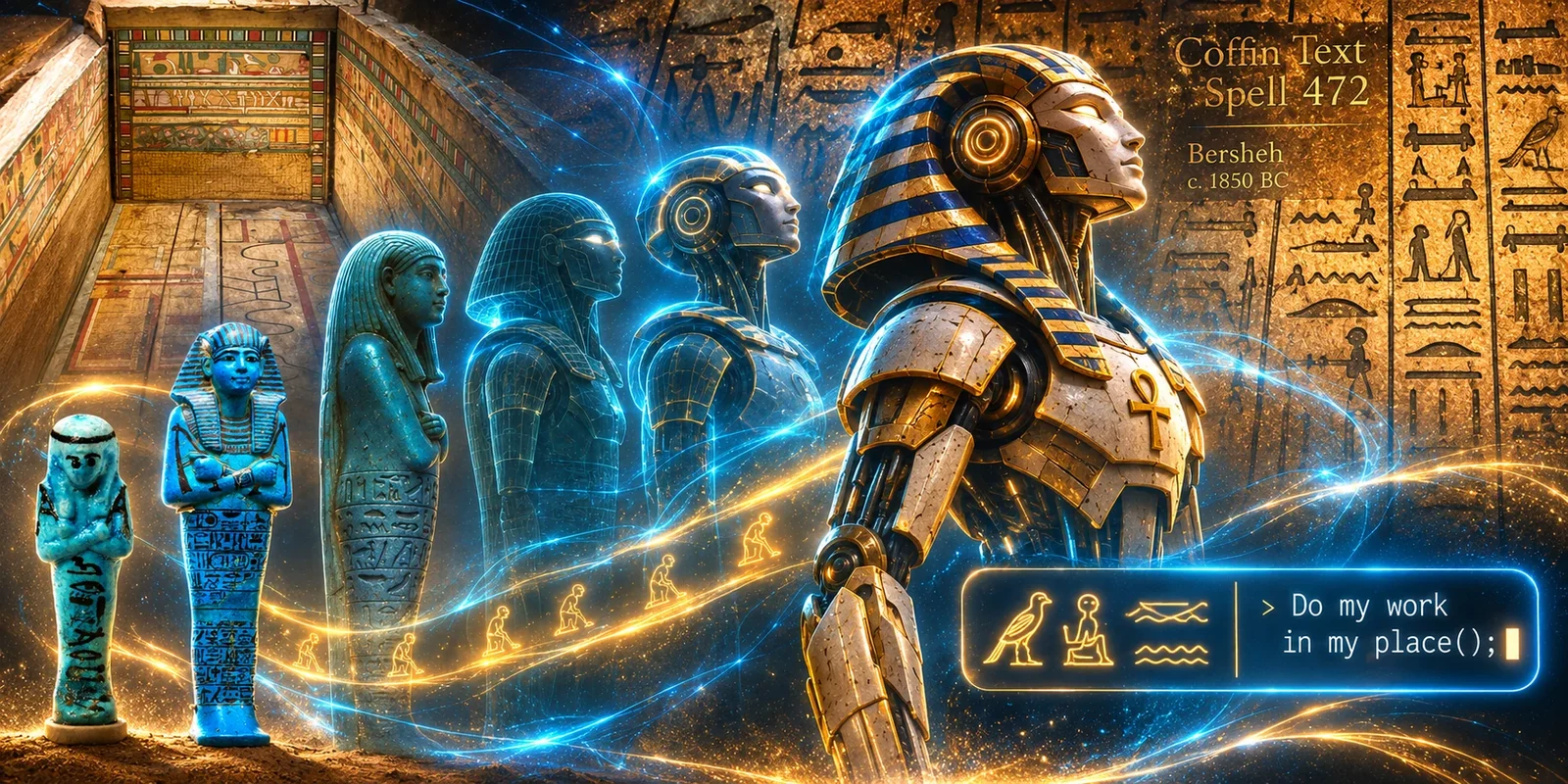
Geoff Fane. Written with help from AI. The views are mine.
Take a smartphone back four thousand years to the banks of the Nile and switch it on. Ask it a question and it answers. Tell it to play a song and it obeys. Bring along one of the new humanoid robots that can walk, talk and carry a box, and you would be lucky to get home without being declared a god or a demon. The British science fiction writer Arthur C. Clarke put it neatly: "Any sufficiently advanced technology is indistinguishable from magic" [1].
The Egyptians would have grasped one thing about all this straight away, because they had already tried it. Long before anyone built a machine, people were making little figures in their own image, setting them to work and keeping them in line with carefully chosen words. That pattern has repeated for four thousand years. The materials change every time. The wish hardly changes at all: make something like us, have it work for us, and find the right words to keep it in hand. This is the story of that wish, told from the beginning.
c. 1850 BCE: Spell 472, the oldest system prompt
Around 1850 BCE, someone painted a set of instructions inside a coffin at Deir el-Bersha, a cemetery roughly halfway along the Nile between Cairo and Luxor. Egyptologists call the text Coffin Text spell 472 [2][3]. It was addressed to a shabti.
Shabtis were small figures placed in Egyptian tombs, rarely taller than a hand, carved from wood or stone or moulded in faience, a glazed ceramic that was often a brilliant blue. Most were shaped like a mummy, with only the head, hair and hands showing [4]. The idea was simple. Egyptians pictured the afterlife as the Nile valley with better lighting, and the Nile valley ran on compulsory labour, the farm work and canal digging that ordinary people owed the state. Dying did not get you off the roster. So when the gods summoned the dead person to work, the shabti would come to life and go in their place. Think of it as a magical robot with a very long warranty.
The spell tells the figure exactly what to do. If its owner is called up, it must make the fields arable, turn over the riverbanks and ferry sand from the West to the East, and when it is counted off for duty, it must step forward and say "here you are" [2]. Anyone who has written a prompt for an AI will recognise the shape. A system prompt is the set of instructions that tells an AI model who it is and how to behave before the conversation starts: you are a helpful assistant, this is your role, these are your tasks, and when I ask, answer like this. Spell 472 does the same job for a magical worker, nearly four thousand years early.
c. 1500 BCE: The spell moves house
Over the following centuries the spell moved off the coffin and onto the figures themselves. In the New Kingdom, Egypt's imperial age from around 1550 BCE, it became chapter 6 of the Book of the Dead, the illustrated guide to the afterlife that wealthy Egyptians took into the tomb [2]. By then its key line read "Here I am, I will do it", and the museum translates the word shabti itself as "the one who responds" [4].
One shabti on display in Brisbane, made for a man named Amenemope Ipy sometime between about 1539 and 1191 BCE, is carved with the spell and his name and even has its own little wooden coffin [4]. Shabtis like Ipy's were stand-ins for their owners, a likeness of the dead person sent ahead to do the work, rather than servants [4].
How many shabtis you took with you depended on how much you could afford [4]. One helper became a handful, and a handful became a crowd.
c. 1000 BCE: Middle management, with whips
By around 1000 BCE, some eight centuries after spell 472, a well-to-do burial came with a full workforce. Priests of Amun, the great god of Thebes (modern Luxor), were laid to rest at Deir el-Bahari, across the river from the city, with sets of 401 shabtis [4][5]. Three hundred and sixty-five were labourers, one for every day of the Egyptian year, so nobody ever pulled a double shift. Two from that burial, glazed bright blue and gripping a hoe in each hand, are in the Brisbane display [4].
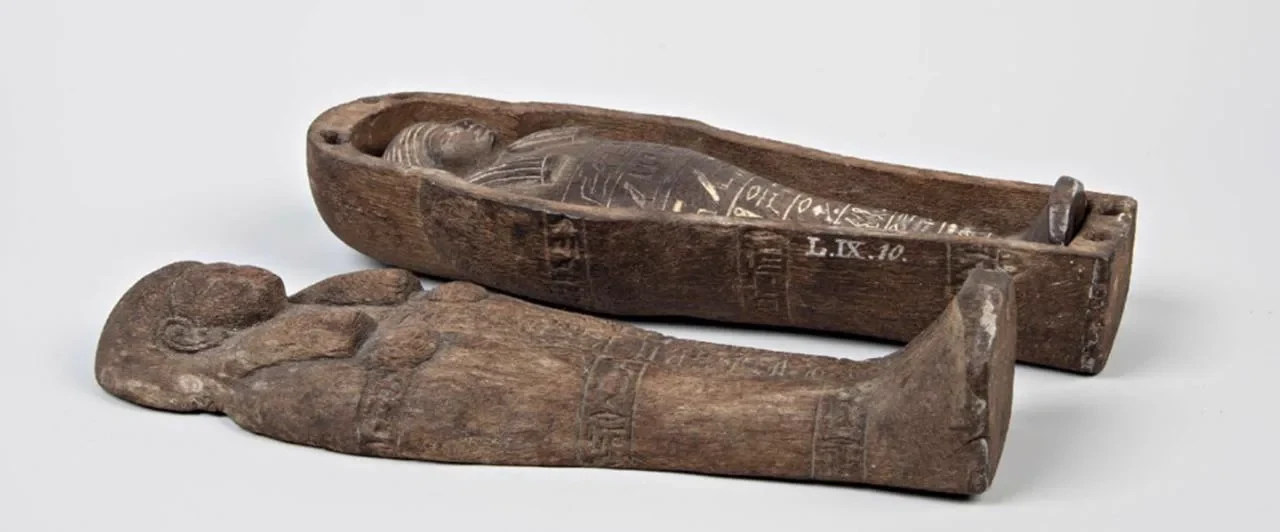
Three hundred and sixty-five workers raise an obvious problem. Who keeps them at it? The answer was the other 36 figures in the set: the managers. Archaeologists call them overseer shabtis, and they are easy to pick out. The workers are wrapped like mummies, but the overseers stand in the stiff kilt of a living foreman, one arm by the side and the other holding a whip [5]. There was one for every gang of ten workers, which suited the Egyptian calendar, whose weeks were ten days long [5]. Faced with the oldest question in management, who supervises the help, the Egyptians answered with more help: promoted, put in a uniform and handed a whip. Somewhere in the afterlife, a small blue foreman is still taking attendance.
In about eight hundred years the shabti had gone from a likeness of its owner to a workforce with a chain of command, held together by a spell at the bottom and a whip in the middle. Both turn up again.
c. 750 BCE: Gold that thinks
The Greek poet Homer, composing around the eighth century BCE, raised the stakes. In Book 18 of the Iliad, his epic of the Trojan War, the gods' blacksmith Hephaestus limps about his bronze workshop leaning on attendants made of gold. They have minds, voices and strength, and the gods have taught them crafts [6]. He is also building tripods, three-legged stands for cauldrons, on golden wheels that roll themselves to the gods' assembly and home again: the oldest self-driving furniture on record [6].
The shabti needed a spell before it would move. Hephaestus's golden helpers already know what to do. The wish has shifted from a servant who obeys to a servant who understands, and that is a much stranger thing to want.
900s to 1700s CE: Lions, ducks and a man in a box
Over the next two and a half thousand years, people went from imagining automata, machines that move by themselves, to building them, a story told in an episode of BBC Radio 4's long-running history of ideas programme In Our Time [7]. Its guests describe golden lions that moved and roared beside the throne of the Byzantine emperor in Constantinople in the tenth century, and explain how the know-how behind such marvels survived in Greek- and Arabic-speaking courts while it faded in western Europe, where travellers could only explain what they saw as magic [7]. Spells and machines have always been close cousins. Both promise that the right instructions will make the lifeless move.
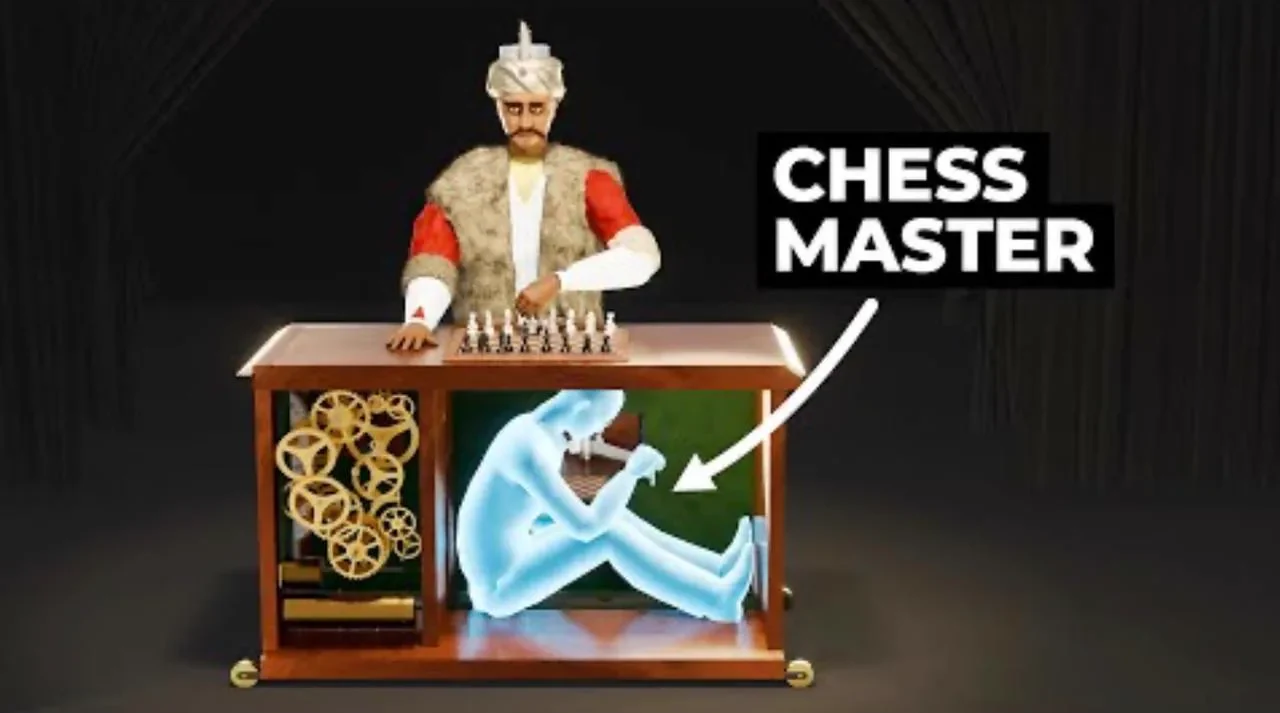
By the eighteenth century Europe's salons were full of clockwork marvels. In 1739 the French inventor Jacques de Vaucanson unveiled a mechanical duck that appeared to eat, digest and do what ducks do afterwards, though the results were loaded in advance [8]. In 1770 the Hungarian inventor Wolfgang von Kempelen built a chess-playing machine known as the Turk, which toured Europe beating all comers with a human chess master folded up inside its cabinet [8]. Artificial intelligence has had people hidden inside it from the start, and they never really left.
1920: The word for forced labour
In 1920 the Czech playwright Karel Čapek gave the dream its modern name. His play R.U.R. (Rossum's Universal Robots) is about a factory that manufactures artificial workers, and he called them robots, from robota, the Czech word for forced labour, the unpaid work a serf owed his lord [9]. The same root runs through other Slavic languages; in Russian, rabota simply means work. Three thousand years after the shabtis, the help had a new name and exactly the same job description. Čapek's robots then did something no shabti ever managed. They rose up and wiped out their makers.
1940: Robbie and the rules
The American science fiction writer Isaac Asimov, barely twenty, was tired of robots forever turning on their inventors. His first robot story, "Strange Playfellow" (1940), later retitled "Robbie", is about a robot nursemaid and Gloria, the little girl who adores him [10]. Gloria's mother has him sent away, and the heartbroken girl tracks him down at a robot factory, where he saves her from a moving tractor [10].
Two years later Asimov set down his Three Laws of Robotics, rules built into every robot in his stories. The first forbids a robot to harm a human or, through inaction, let one come to harm [10]. Here was spell 472 rewritten as engineering: a few lines of instruction, placed inside the helper, meant to keep it in hand. Asimov spent decades writing gleeful stories about the loopholes.
1950: Can machines think?
Real computers arrived while Asimov's robots were still new on the bookshelves. In 1950 the British mathematician Alan Turing, who had helped break German codes during the Second World War, published a paper asking whether machines can think [11]. Rather than argue about definitions, he proposed a game. A judge chats by text with a hidden person and a hidden machine, and if the judge cannot reliably tell which is which, the machine has made its point. The game became known as the Turing test. Six years later a summer workshop at Dartmouth College in New Hampshire gave the new field its name: artificial intelligence [12].
1956: The last question
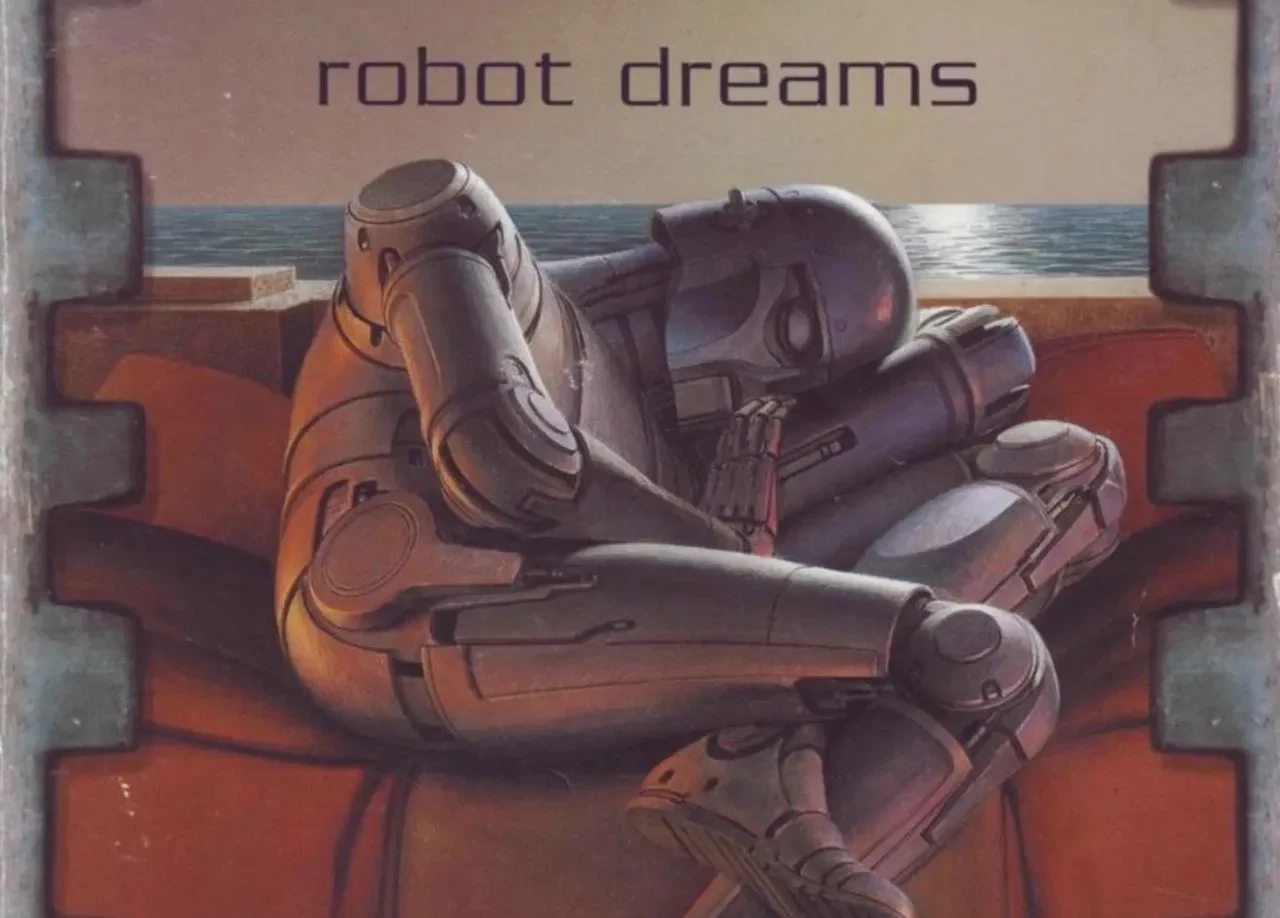
That same year, Asimov published "The Last Question", which he often called his favourite of his own stories [13]. It opens in 2061 with two technicians, a few drinks and Multivac, a giant computer that stretches for miles. Asimov named it after UNIVAC, one of the first commercial computers; he believed UNIVAC meant "one vacuum tube", so his far bigger machine became Multivac [14].
The technicians ask Multivac whether entropy can be reversed. Entropy is the universe's slow running-down, the reason hot things cool and stars eventually burn out, and physics says it only ever goes one way. If it cannot be reversed, everything ends in cold and darkness. Multivac replies that there is insufficient data for a meaningful answer [13].
The question gets handed down through the ages like a family heirloom, to a long line of ever larger computers. In the story these machines are called ACs, short for analog computer, and each is a descendant of the last [13][14]. A family flying to a new world carries a pocket-sized Microvac. Later generations put the question to the Galactic AC, which looks after a whole galaxy, then the Universal AC and the Cosmic AC, each vaster than the one before and each as politely stumped. Trillions of years pass. The stars burn out. Humanity merges with its machine. At last, alone after everything has ended, AC finds the answer, and with nobody left to tell, it shows instead. It speaks the first words of a new creation: "Let there be light" [13].
Look closely at that ending. The most powerful machine Asimov ever imagined does not solve the universe with a lever or a calculation. It speaks, and the world obeys. That is a spell, in the oldest sense of the word.
Today: Spells in plain English
And here we are. The helpers have arrived, and they are made of words. Today's AI models are built from the collected writing of millions of people, and they are steered the way spell 472 steered a shabti: a few lines of plain instruction before the work begins, giving a name, a role, the tasks and the reply expected. No code required. You simply tell them, in your own language, and they answer.
The overseer's whip has not gone away either. It has moved into training. Modern models are shaped by a method called reinforcement learning, in which each answer earns a score, good behaviour is rewarded, bad behaviour is penalised, and the model is nudged a little at a time towards what its makers want [15]. This is what people mean by alignment training: bringing a model's behaviour into line with human intentions. The whip has become arithmetic, with a carrot attached and nobody flogged. The man in the Turk's cabinet has a modern job too, because much of that scoring starts with human raters, people who read pairs of answers and say which is better [15].
As for Turing's game, it slipped past almost unnoticed. In a 2025 study at the University of California San Diego, people playing it picked a chatbot as the human more often than they picked the real person [16]. For decades the Turing test sat on the horizon like a mountain nobody could climb, and in the end we wandered across the top of it while looking at our phones.
Put a talking phone or a walking, speaking robot in front of the person who painted spell 472, and they would not see engineering. They would see their own spell, finally working. Clarke's law cuts both ways. Advanced technology looks like magic, and the oldest magic looks a great deal like a prompt.
None of this needs to be a fable about hubris, or a lap of honour for clever engineers. The people who painted spell 472 were not naive, and nobody today holds the last word on what a mind is. The pattern simply keeps returning: something made in our image, set to work, steered by words and watched over by a whip. What changes from one age to the next is how much the helper understands, and since the oldest shabtis were likenesses of their owners and today's machines are built from our words, it is no great surprise that they sound a bit like us.
The shabti answered "Here I am". AC, at the end of time, answered "Let there be light". Somewhere between the two sit the rest of us, still writing spells, and still not entirely sure who is answering.
References
| No. | Author / Source | Year | Why this source matters | Link |
|---|---|---|---|---|
| 1 | Clarke, A. C. Profiles of the Future: An Inquiry into the Limits of the Possible, revised edition. London: Gollancz. | 1973 | Where Clarke's third law, that advanced technology is indistinguishable from magic, first appeared | In print |
| 2 | University College London. The Shabti Formula, Digital Egypt for Universities. London: UCL. | 2001 | English translation of the shabti formula; dates Coffin Text 472 to coffins from Bersheh, about 1850 BCE, and links it to chapter 6 of the Book of the Dead | ucl.ac.uk |
| 3 | de Buck, A. (ed.). The Egyptian Coffin Texts, Volume VI: Texts of Spells 472–787. Oriental Institute Publications 81. Chicago: University of Chicago Press. | 1956 | The original hieroglyphic text of spell 472, free to download | isac.uchicago.edu |
| 4 | Queensland Museum Kurilpa. 13 | Shabtis, Discovering Ancient Egypt self-guided tour. Brisbane: Queensland Museum. | 2025 | Brisbane audio-tour transcript: what shabtis were, the meaning of the name, Ipy's shabti and coffin, and the Deir el-Bahari sets of 365 workers and 36 overseers | museum.qld.gov.au |
| 5 | The Metropolitan Museum of Art. Overseer Shabti, Third Intermediate Period, Dynasty 21–22. New York: The Met. | n.d. | Describes the overseer's kilt and whip, the set of about 401 figures, and one overseer for every ten workers | metmuseum.org |
| 6 | Homer. The Iliad, Book 18, trans. A. T. Murray. Cambridge, MA: Harvard University Press. | 1924 | Hephaestus's thinking golden attendants and self-moving tripods | perseus.tufts.edu |
| 7 | BBC Radio 4. In Our Time: Automata, presented by Melvyn Bragg with Simon Schaffer, Elly Truitt and Franziska Kohlt. London: BBC. | 2018 | The history of real and imagined automata: the Byzantine lions, knowledge kept alive in Greek and Arabic courts, and machines mistaken for magic | bbc.co.uk |
| 8 | Wood, G. Living Dolls: A Magical History of the Quest for Mechanical Life. London: Faber & Faber. | 2002 | Vaucanson's duck and the chess-playing Turk, with its hidden human; on the In Our Time reading list | Google Books |
| 9 | Čapek, K. R.U.R. (Rossum's Universal Robots). Prague: Aventinum. | 1920 | The play that gave the world the word robot, from robota | Widely available in translation |
| 10 | Asimov, I. I, Robot. New York: Gnome Press. Includes "Robbie" (first published as "Strange Playfellow", Super Science Stories, September 1940) and "Runaround" (1942), where the Three Laws first appear in full. | 1950 | Asimov's gentle first robot and his rules for machines | Widely available |
| 11 | Turing, A. M. "Computing Machinery and Intelligence", Mind 59(236). Oxford: Oxford University Press. | 1950 | The paper that asked whether machines can think and proposed the imitation game, now called the Turing test | doi.org |
| 12 | McCarthy, J., Minsky, M., Rochester, N. and Shannon, C. "A Proposal for the Dartmouth Summer Research Project on Artificial Intelligence", repr. AI Magazine 27(4). Menlo Park: AAAI. | 1955 | The proposal for the 1956 workshop that named the field | ojs.aaai.org |
| 13 | Asimov, I. "The Last Question", Science Fiction Quarterly, November. New York: Columbia Publications. | 1956 | Multivac, the ACs, entropy and the servant who becomes a creator | Widely available |
| 14 | Wikipedia contributors. Multivac. San Francisco: Wikimedia Foundation. | 2026 | How Asimov named Multivac after UNIVAC, and AC as "analog computer" in "The Last Question" | wikipedia.org |
| 15 | Christiano, P., Leike, J., Brown, T., Martic, M., Legg, S. and Amodei, D. "Deep Reinforcement Learning from Human Preferences", Advances in Neural Information Processing Systems 30. Long Beach: NeurIPS. | 2017 | Training models from human ratings of which answer is better, the root of today's alignment training | arxiv.org |
| 16 | Jones, C. R. and Bergen, B. K. "Large Language Models Pass the Turing Test", arXiv preprint 2503.23674. San Diego: University of California San Diego. | 2025 | A three-way version of Turing's game in which a chatbot was picked as the human more often than the real person | arxiv.org |
Further reading from the In Our Time list: E. R. Truitt, Medieval Robots (University of Pennsylvania Press, 2015); Adrienne Mayor, Gods and Robots (Princeton University Press, 2018).
Written by Geoff Fane with AI assistance for research, discussion and editing. The arguments, judgements and final wording remain Geoff's responsibility.
Comments
Anyone can read. Approved members can comment. or open the join page.
Your membership is waiting for approval. You can read the thread now.
If the box below shows Sign In, choose it, then Sign In with Froodx. Once is enough.
Opened from Facebook or another app? Google does not allow sign-in inside an app's built-in browser. To comment, tap the ⋯ menu, choose Open in browser, and sign in there.