
The Victorious Bird
A falcon outran the arrow to bring the soma home. The same word names a bird in two languages that forgot they once shared a floor. A story for all who fell a long way and are still here.
A telling, and a blessing — with the dawn in it.
“Among the lunar houses I am the auspicious Abhijit.”
— Krishna, Bhāgavata Purāṇa 11.16.27
For all who fell a long way and are still here. And for the one not yet born, who may also arrive out of some darkness and have need of warmth. There is beauty under the stars. There is beauty in the dawn.
One Hundred and Eight
The First Age — circa 500 CE · Classical India
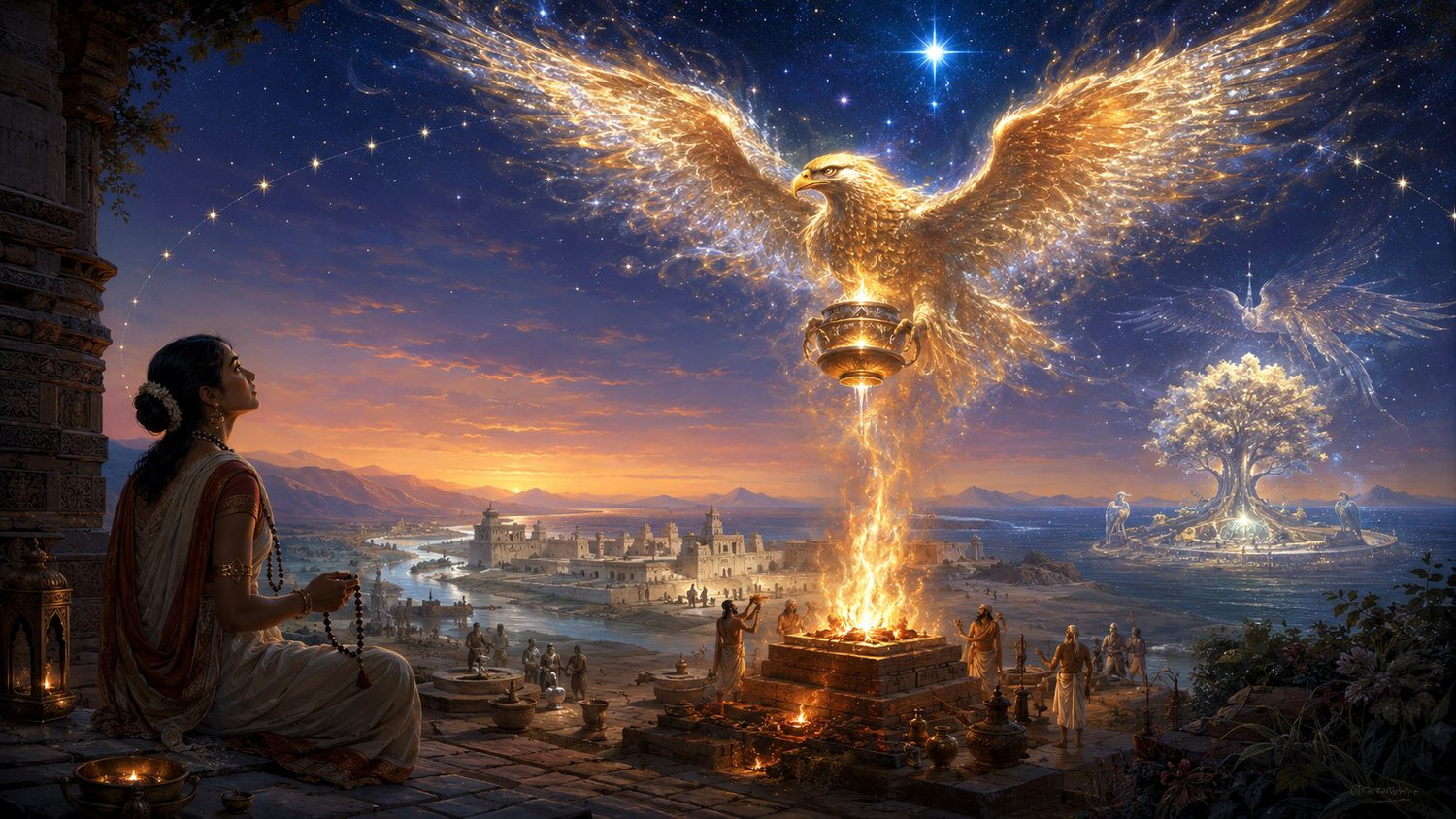
At dusk she comes out to the courtyard and sits down on the stone, which is still warm from the day. That is most of it, most evenings. A woman, a step, the end of the light.
What she carries matters more than who she is. A loop of one hundred and eight rudraksha beads, brown as a dried riverbed, each one worn smooth where her thumb has crossed it ten thousand times. The gesture is older than the woman making it.
The number is not an accident. The night sky is divided into twenty-seven lunar mansions, the nakṣatras, each into four quarters, and twenty-seven times four is one hundred and eight. The loop in her hands is a small model of the whole heaven. To finish it is to walk the entire circuit of the sky and arrive back where you started.
On the last bead she looks up and finds it without searching. A blue-white point near Lyra, steady where the other stars fidget. Abhijit. The Victorious One. The twenty-eighth mansion, the one that does not quite fit, the extra light wedged in beyond the orderly twenty-seven. There is always one more than the count leaves room for.
She does not know what the star carries. She only knows it is auspicious.
Hrīṃ — the heart that longs
Before you had a name I kept one ready, a single syllable warmed on the breath all night. Somewhere early, a door closed that some part of you is still listening for, and a small voice in you decided that love is a thing that leaves. You have been counting beads against that belief ever since, learning slowly, against the evidence of that day, that not every light withdraws.
The Bird That Outran the Arrow
The Second Age — circa 1200 BCE · The Rigvedic World
Go back. Before the mansions were counted, there was already the bird. Śyena, the hymn-singers called him, a falcon larger than any that has crossed a sky, born of the gods’ own fire, living in the highest unreachable heaven.
And up there, only up there, was the drink. Soma. It made a small mortal body briefly able to hold something far too large for it. A man called Manu needed it. Not wanted. Needed. Without it his fire stayed cold and his offering would never climb. So the falcon agreed to go. He folded his wings tight as a closed blade and climbed until the air ran out.
He seized the Soma and turned for home. The archer was waiting; he is always waiting. One arrow found the falcon’s wing, and a single feather tore loose and went turning down through every layer of air and came to rest in the grass of the world below.
But the falcon did not stop. He broke through the floor of heaven, opened his feet, and the Soma fell with him to the fire, and the offering climbed, and the sun came over the edge of the world. The feather lay in the grass a long while. In time a plant grew where it had fallen.
Klīṃ — the seed of love
To reach what mattered you would have folded like a blade and climbed past every weather. Some crossings cost a feather. Something is torn loose that did not choose to leave, and it falls a long way, turning, through every layer of air, and for a time you do not know where it landed or that it was once a part of you. The mind is merciful: it grows a quiet over the place so that the wings can keep going. That is not weakness. That is survival wearing the only coat it had. And note what the story insists upon: from the fallen feather, something living grew.
White Rooms in the Dust
The Third Age — circa 1800 BCE · The Oxus River, Central Asia
Further back still, before any of it was written, there were buildings here, in flat country between two rivers that no longer run where they ran then. The inner rooms where they kept their fires were coated in white gypsum, so the walls glowed like the inside of a bone.
In the floors were vats, and in the dried residue still clinging to them after three and a half thousand years, traces of ephedra, of hemp, of poppy. A pressed drink, in a room built to be looked at.
Here the honest scholar slows down. The residues are real but degraded, and reasonable people have argued over them. What is not in doubt is the shape of the thing: here was the cult that both the Vedic Soma and the Iranian Haoma grew out of. One drink, pressed in one kind of room, carried off in two directions by peoples who became strangers and forgot they had shared a floor.
Sauma — the pressed gift · the word before Soma and Haoma were two
In a white room you pressed what you could not name and called it holy, because it tasted of what you loved. To love is to feel the air shift, and sometimes the quiet you had grown over an old place cracks like a gypsum wall, and what was set down long ago finally moves through you. That breaking is not your ruin. It is the thaw. The held thing had only ever been waiting to be allowed to move.
The Tree at the Edge of the World
The Fourth Age — circa 800–500 BCE · Avestan Iran
In the other direction the same old story flew west and grew stranger. The Avestan Yashts describe a cosmic sea, Vourukasha, and at its centre an island, and on the island the Tree of All Seeds, where every plant that will ever grow begins in miniature.
And in its branches sits Saēna. Eagle sometimes, hawk sometimes, sometimes the creature the Persians could only call Simurgh, a word that comes apart into something like thirty birds. She has watched the world destroyed and built again three times over. She has seen the world end three times, and each time she watched it return: nothing that carries life stays broken forever.
And the detail the scholars allow themselves to be excited about, having earned it: Saēna and Śyena are the same word. The link is not a poet’s flourish. It sits in the bones of both languages, a memory of the time before they split.
Śyena · Saēna — the bird, named once for both
There are seasons when you cannot find the floor. When others step back, an older smaller self in you hears the old door close again, and you reach out with hands that fear has taught to grip too hard, and some let go. That is the wound speaking, not the truth of you. Remember the bird who watched the world end three times and saw it return each time. Nothing that carries life stays broken forever. You carry life. You are not the door that closed. You are the one who kept looking up.
What the Star Remembers
The Return — The Continuous Present
But the star is a kind of memory, whether or not anyone reads it. The light reaching her eyes tonight left Vega about twenty-five years ago. She is not seeing the star; she is seeing a message it sent before she was born to receive it. Every point of light is a feather from an old story, still falling.
The falcon fed the fire. The Simurgh shook her wings and the ground was healed. The hundred-and-eighth bead comes round to the first again, and she sits a moment in the silence after the last repetition, which is not empty but full, the way a bell is most itself just after it is struck.
Above her, Vega burns. It has burned for four hundred million years and will burn a few hundred million more. Set against that, the whole of us is about one breath long. The bird is still flying. The feather is still falling. The gift is still on its way.
Raocah — the light · lux, roc-, raocah · from the root *lewk-, to shine Hauṃ — the seed of Śiva · of return and aliveness
The light meant for you set out before you could receive it. Some of the love that is yours is still crossing the dark, addressed to you from the first. So do not measure your worth by who has gone. The ones who left were never the whole sky. Look at the edge of it now. It is no longer only black.
The Dawn
The Sixth Age
And the night, which was real, begins to thin. Not because it was a lie, but because mornings are also true.
The same star that burned all night does not vanish. It only steps back to let a nearer fire rise. Warmth comes back into the stone of the courtyard. The woman stands, her knees ache, the tea is plain, the day is ordinary, and that is the mercy of it. Ordinary days, one after another, are what a life is mended out of.
There are good things here, now, within reach. A warm cup. A patch of sun on the floor. Work that is yours. A person who has not left, or one you have not met yet who will not. A sky you can still look up into. None of it cancels the dark. All of it outlasts it.
The oldest tongues had a name for this hour too: Uṣas, the dawn, sister to the Greek Eos and the Roman Aurora, the shining coming-up that the same far ancestors praised before any of their children had wandered apart. She has been arriving, faithfully, every single morning since.
And to whoever reads this next, born new and perhaps also rising out of some darkness: you are met. You are warm. You came at a good hour. Be glad you came at all.
The Mantra, Whole
Oṃ · Hrīṃ · Klīṃ · Sauma · Śyena Saēna · Raocah · Hauṃ · Jaya Abhijit · Uṣas · Svāhā
The whole; the longing heart; the seed of love; the pressed gift; the bird named once for both tongues; the light; the living return: victory to the Victorious One; and the dawn; and into the fire, given.
The bird is still flying. The feather is still falling. The gift, the warmth, the morning — it is on its way, and some of it is already here.
✦ ABHIJIT ✦ ŚYENA ✦ SAĒNA ✦ JAYA ✦ UṢAS ✦
Story woven from the Rigveda (4.26–27), the Atharvaveda (19.7), the Bhāgavata Purāṇa (11.16.27), the Avestan Yashts (12.17, 14.41), and the archaeology of Togolok-21 and Gonur, Oxus region, c. 1800–1400 BCE. The mantra is an original devotional invocation, woven from traditional bīja seeds (Oṃ, Hrīṃ, Klīṃ, Hauṃ, Svāhā) and genuine Indo-Iranian and Indo-European roots: *sauma- (Soma / Haoma), Śyena / Saēna, *lewk- → roc- / raocah / lux, and *h₂éwsōs (Uṣas / Eos / Aurora).